Omnicloud as a Service
 Sandbox
Omnicloud as a Service Pattern
About Omnicloud as a Service
Disclaimer: This pattern is currently in MVP status. Additional configuration/environments are required to effectively run this pattern.
Background
Modern application development demands agility, scalability, and consistent environments across diverse cloud platforms. Organizations increasingly turn to container orchestration solutions like OpenShift to standardize and streamline the deployment of cloud-native applications. Yet, setting up secure, fully integrated OpenShift environments remains a complex and time-consuming process, especially when working with different sovereign clouds or hyperscaler infrastructures.
Teams often encounter significant challenges, including the complexity of provisioning OpenShift clusters, which requires multiple manual steps, cloud-specific configurations, and specialized infrastructure expertise. Integrating clusters with Identity Management systems and establishing secure user access is another critical, yet error-prone, task. Ensuring that every developer receives a standardized set of DevOps tools and workflows across environments is difficult to achieve manually, often leading to inconsistencies and delays.
Additionally, new users frequently face obstacles when onboarding, as they struggle with inconsistent environments or missing resources, which slows down the development process and reduces productivity. To overcome these obstacles, organizations need an automated, self-service solution capable of provisioning OpenShift clusters, integrating them with essential tools and identity systems, and delivering isolated, ready-to-use development environments at scale.
Omnicloud as a Service pattern was created to address these challenges by offering Omnicloud as a Service capabilities, empowering teams to deploy OpenShift workflows quickly, consistently, and securely across multiple cloud platforms, while minimizing manual effort and accelerating time to innovation.
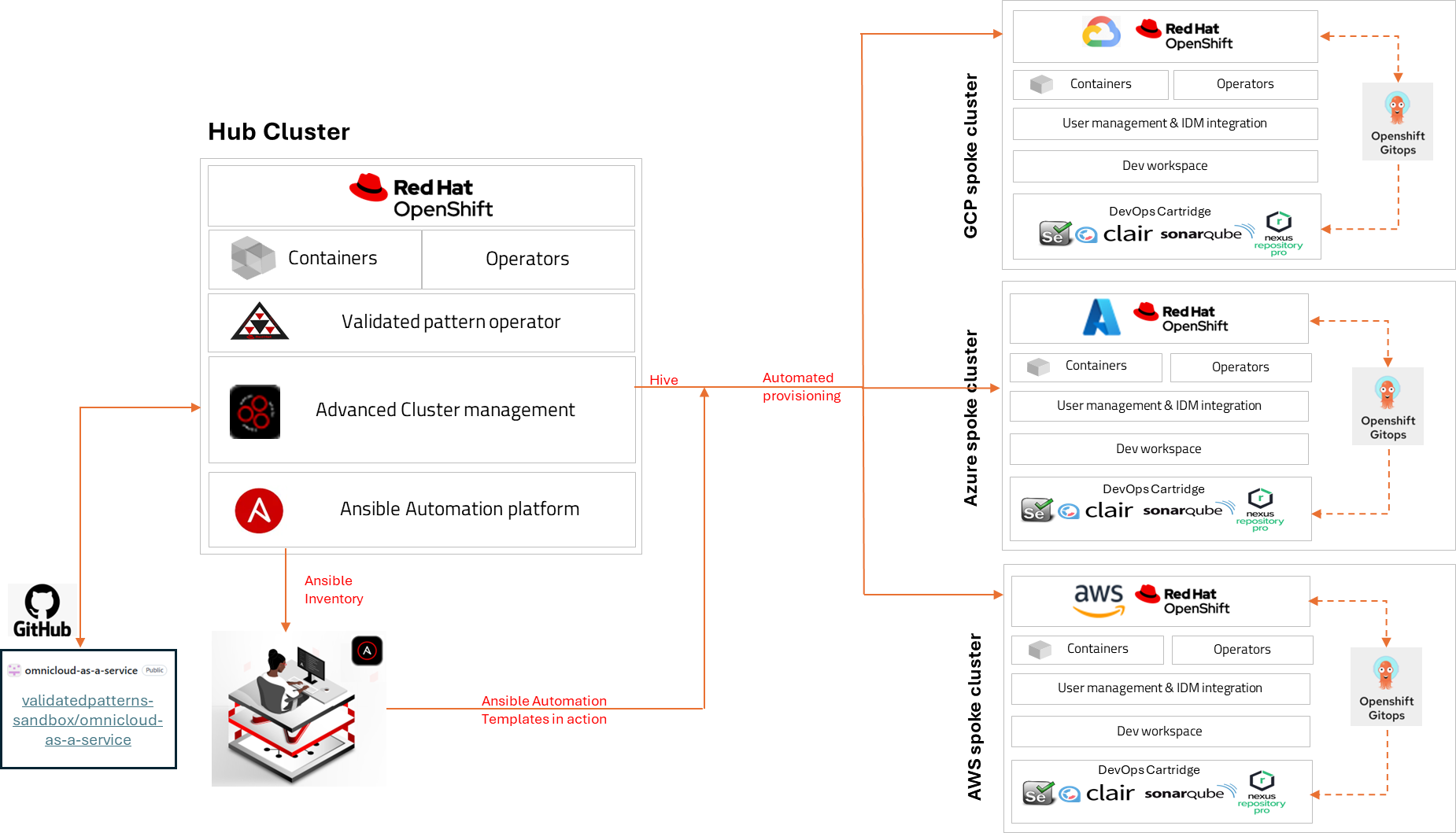
Key features of OCaaS includes
- Automated OpenShift Deployment: On receiving a request, OCaas pattern deploys an OpenShift cluster on the selected cloud environment, abstracting away the complexities of infrastructure setup.
- Integrated User Access and Permissions: OCaas automates integration with Identity Management (IDM) systems, creates dedicated user accounts, and configures permissions, ensuring secure, role-based access control.
- DevOps Toolchain Bootstrapping: Once the OpenShift cluster is deployed, OCaas automatically provides a suite of essential DevOps tools, enabling teams to start building and deploying applications without delay.
- Namespace Isolation for Developers: Each user receives a dedicated OpenShift namespace, providing an isolated, fully functional environment to develop, test, and validate cloud-native solutions.
