Pattern
RamenDR Starter Kit

Status
 Sandbox
SandboxResources
RamenDR Regional Disaster Recovery with Virtualization Starter Kit
This pattern sets up three clusters as recommended for OpenShift Data Foundations Regional Disaster Recovery as documented here.
Of additional interest is that the workload that it sets up protection for and can failover involves running virtual machines.
The setup process is relatively intricate; the goal of this pattern is to handle all the intricate parts and present a functional DR-capable starting point for Virtual Machine workloads. In particular this pattern takes care to sequence installations and validate pre-requisites for all of the core components of the Disaster Recovery system.
You might fork the repository to customize chart values (for example aws.region in
charts/hub/rdr/values.yaml)
or to select a non-default install variant. The Getting started page describes variant
selection, BYOC, required secrets, and verification steps.
Install variants
The pattern ships three install variants under variants/ in the repository. Set main.variant in
values-global.yaml
before install. The default is odf.
| Variant | main.variant | Purpose |
|---|---|---|
|
| Full OpenShift Data Foundation Regional DR with OpenShift Virtualization workloads, MirrorPeer, and failover-capable VMs |
|
| Partner CSI foundation with hub S4 object storage: OADP, OpenShift Virtualization, Ramen/Multicluster Orchestrator; infrastructure DRClusters and a |
|
| Partner CSI foundation without S4, Submariner, or DRCluster sync/validation: OADP, OpenShift Virtualization, and Ramen/Multicluster Orchestrator only (Hive or BYOC bring-up) |
Spoke configuration files nest under each variant as variants/<variant>/values-<managedClusterGroup.name>.yaml.
See Installation details for what each variant deploys on the hub and managed clusters.
For component schematics, connectivity paths, and TLS/CA handling, see Architecture and Connectivity.
Background
It would be ideal if all applications in the world understood availability concepts natively and had their own integrated regional failover strategies. However, many workloads do not, and users who need regional disaster recovery capabilities need to solve this problem for the applications that cannot solve it for themselves.
This pattern uses OpenShift Virtualization (the productization of Kubevirt) to simulate the Edge environment for VMs.
Red Hat Technologies
Red Hat OpenShift Container Platform (Kubernetes)
Red Hat Advanced Cluster Management (RHACM)
Red Hat OpenShift Data Foundations (ODF, including Multicluster Orchestrator)
Submariner (VPN)
Red Hat OpenShift GitOps (ArgoCD)
OpenShift Virtualization (Kubevirt)
Red Hat Enterprise Linux 9 (on the VMs)
Architecture overview
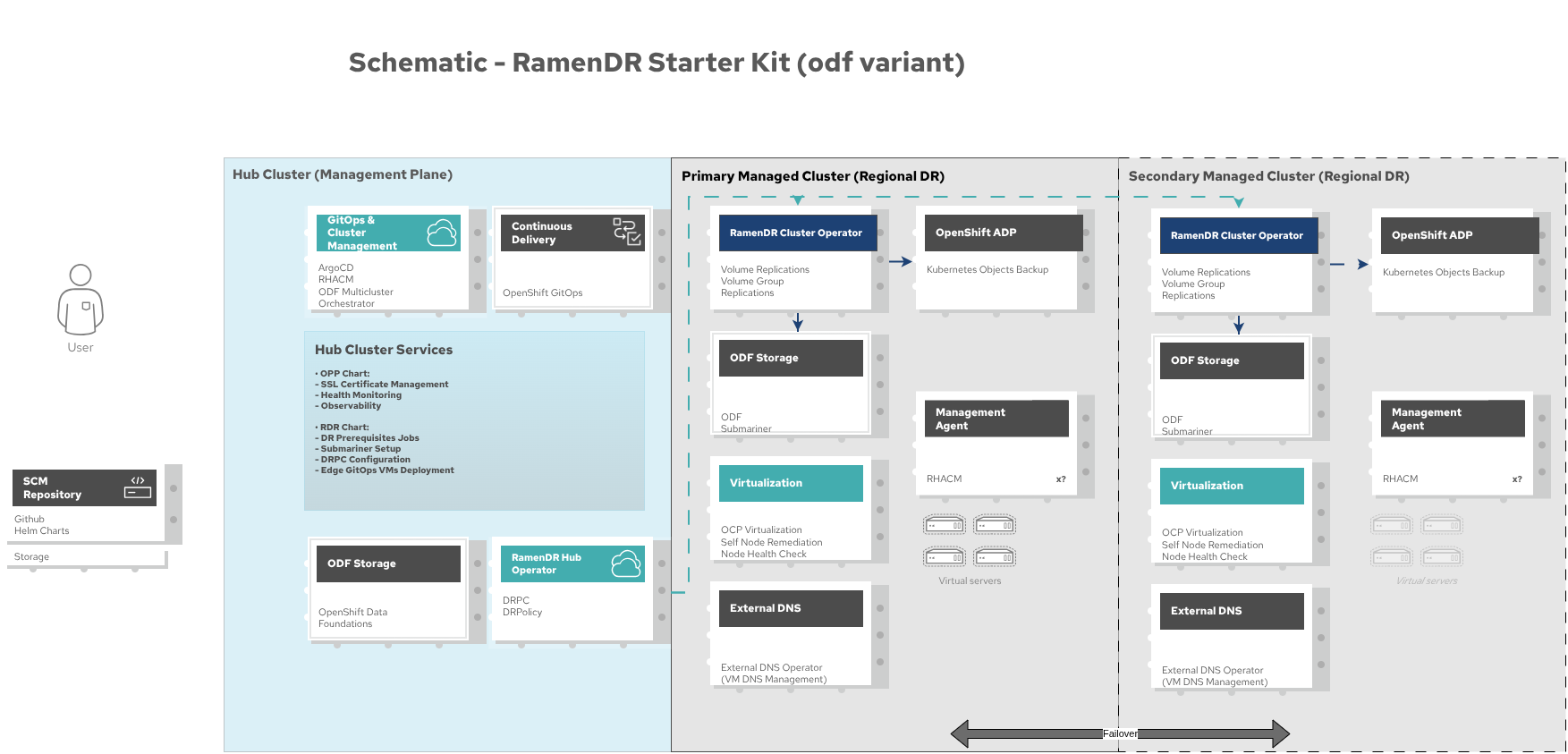
The default odf variant deploys a three-cluster Regional DR layout with OpenShift Data Foundation, Submariner, DRPC-protected VMs, and failover workflows documented in Getting started.
Figure 1. RamenDR Starter Kit architecture (odf)
draw.io source: ramendr-architecture-odf.drawio
Partner variants use different S3 and replication models. See Architecture for per-variant schematics and draw.io sources, and Connectivity for hub-to-managed network paths and ports.
Next steps
Architecture — Component schematics, TLS/CA, draw.io sources
Connectivity — Hub-to-managed connectivity by variant
Getting started — Prerequisites, variant selection, BYOC, and deployment
Installation details — Install sequence and pattern scripts
