Pattern
RHOSO GitOps

Status
 Sandbox
SandboxResources
About the RHOSO GitOps pattern
Deploying Red Hat OpenStack Services on OpenShift spans Operators, networking, and control-plane and data-plane resources. Teams that rely on imperative scripts or manual cluster changes face slow rollouts, configuration drift, and weak audit trails when you upgrade or reproduce the stack.
The RHOSO GitOps pattern addresses that by driving RHOSO from public Git through Argo CD. Manifests stay declarative and version-controlled, and Argo CD reconciles the cluster to match what the repository declares.
Pattern goals
The RHOSO GitOps pattern aims to:
Install the rhoso-gitops meta-chart through the Validated Patterns clustergroup and Red Hat OpenShift GitOps Operator
Create child Argo CD Applications that sync RHOSO stages from upstream openstack-k8s-operators/gitops (
example/*Kustomize overlays)Target one Red Hat OpenShift Container Platform cluster only; no managed-cluster spokes are in scope
Keep day-two changes reviewable in Git instead of one-off
ocor Ansible runs
Red Hat technologies
The RHOSO GitOps pattern uses the following Red Hat products:
Red Hat OpenShift Container Platform
Red Hat OpenShift GitOps
Red Hat OpenStack Services on OpenShift
Cluster scope
Validated Patterns distinguishes between the initial cluster (where you install the pattern) and managed clusters (additional Red Hat OpenShift Container Platform clusters or hosts managed from that hub, for example through RHACM).
The RHOSO GitOps pattern is single-cluster only. It does not include multi-cluster support, spoke provisioning, or hub-to-spoke GitOps fan-out.
| Scope | Supported | What applies |
|---|---|---|
Initial cluster | Yes | Validated Patterns clustergroup ( |
Managed clusters | None | Not in scope ( |
Sizing guidance under requirements.hub in the pattern repository applies to
the single target cluster. Managed-cluster requirements (for example eventual
consistency across spokes) do not apply to this pattern.
Support
This is a sandbox tier pattern. The community provides support on a best-effort basis. For details, see the support policy in the pattern repository.
RHOSO GitOps pattern architecture
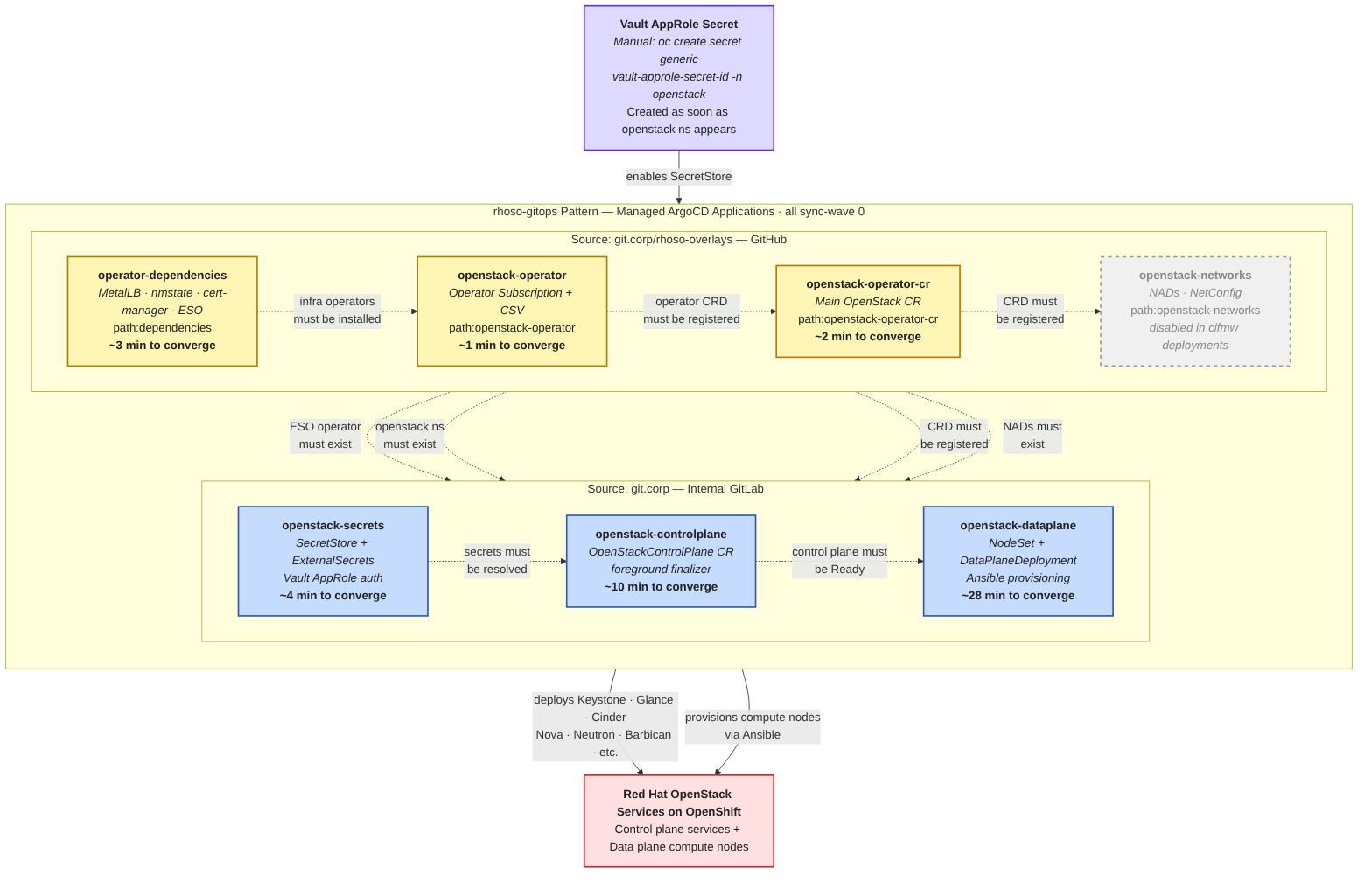
The RHOSO GitOps pattern delivers RHOSO configuration through Argo CD Applications that the rhoso-gitops meta-chart creates. The pattern uses GitOps delivery through a single Argo CD namespace, manages infrastructure topology, and converges deployment through retry policies.
GitOps delivery flow
The pattern uses the Validated Patterns framework to install the
rhoso-gitops Helm meta-chart. That chart creates Argo CD Application
resources that sync RHOSO stages from the upstream
openstack-k8s-operators/gitops
repository (example/* Kustomize overlays).
The delivery path is:
The Validated Patterns Operator reconciles the pattern clustergroup
The parent rhoso-gitops Application runs in
vp-gitops(Validated Patterns GitOps)The meta-chart renders child Applications in the same
vp-gitopsnamespaceThe child applications sync upstream
example/*overlays (Operators, networks, control plane, data plane) and converge through retry policies
Figure 1. GitOps application delivery
All child Applications deploy at sync-wave 0 and converge eventually through retry policies.
Argo CD namespace
The pattern runs all Argo CD Applications in a single vp-gitops namespace,
enabled by global.singleArgoCD: true in values-global.yaml. The
Validated Patterns Operator deploys the parent rhoso-gitops Application into
vp-gitops, and the meta-chart creates child RHOSO Applications in
the same namespace.
For more information about this option, see the single ArgoCD blog post.
Infrastructure topology
An Red Hat OpenShift Container Platform cluster hosts the RHOSO control plane (OpenStack Operators
and OpenStackControlPlane services on control-plane nodes). Separate RHEL
hosts run the RHOSO data plane (data plane elements on compute nodes).
The GitOps delivery flow defines how configuration reaches the cluster. The infrastructure topology defines what gets deployed:
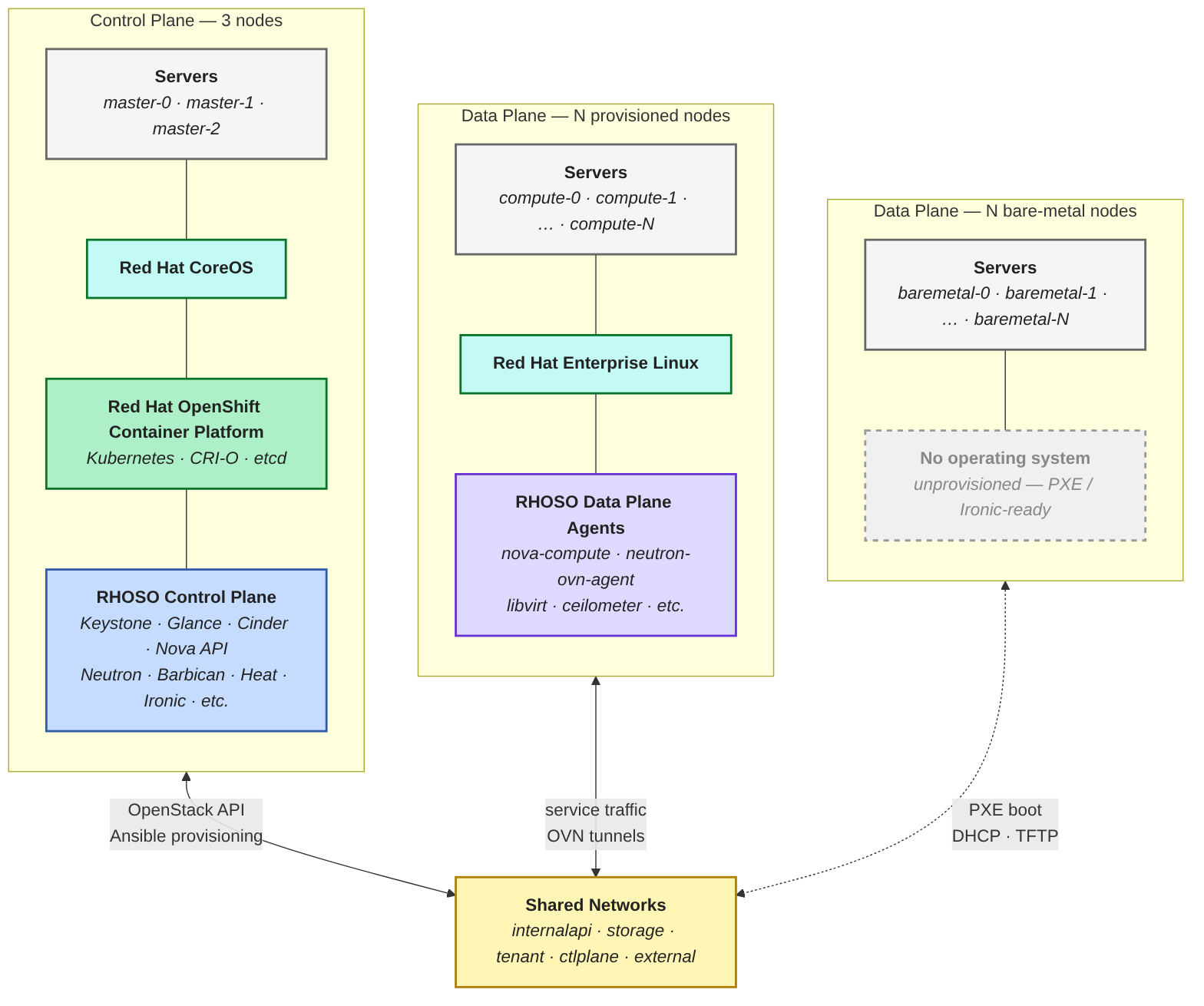
Figure 2. RHOSO infrastructure topology
Red Hat OpenShift Container Platform cluster: Control-plane nodes run OpenStack Operators and
OpenStackControlPlaneservices.Data plane hosts: One or more RHEL compute nodes run RHOSO data plane elements and connect to the control plane.
Deployment convergence
All child Applications deploy at sync-wave 0 (the default) when Argo CD
reconciles the parent rhoso-gitops Application. Argo CD launches every child
simultaneously. Each child retries (per syncPolicy.retry) until its upstream
dependencies resolve and it converges eventually.
For the full list of child applications, their upstream paths, and links to the corresponding Red Hat OpenStack Services on OpenShift product documentation, see Configuration > Upstream applications.
After you change overrides, confirm child applications in the Argo CD UI or with
oc get applications -n vp-gitops.
