
ESO and Vault
| The Validated Patterns team settled on using references to secrets |
We currently implement GitOps + Secrets via External Secrets Operator and HashiCorp Vault
The main reasons for this choice at the time were the following:
Sealed Secret approach carries additional risks
ESO allows us a certain level of independence from the Secrets Management System
HashiCorp Vault is currently the most popular Secret Management Systems
Advised by our security team
CyberArk leaders (masters) cannot be hosted on OpenShift
Secret injection is incompatible with Pods owned by Operators
Approaches
There are two fundamental approaches to manage secret material within a GitOps context:
Encrypted Secrets stored inside Git repositories
References to Secrets stored inside Git repositories and the actual secret is stored somewhere else
Encrypted Secrets
Secrets are stored in an encrypted form inside the Git repository
Automation and helper tools do the decryption to create Kubernetes secrets from them
A number of projects exist that implement this approach:
These projects provide an easy way to encrypt and decrypt the secrets, and make sure that only authorized users can access them. The encryption method and key management should be considered carefully as they are important to ensure the security of the secrets.
| You should evaluate and choose the right project that fits your specific use case and requirements. |
References to Secrets
This approach requires two main parts: * A Secret Management System (HashiCorp Vault, Conjur, Confidant) * A controller that retrieves the secret from the Secret Management System and translates it to a Kubernetes Secret or injects it into the Pod directly (External Secrets Operator, Kubernetes Secrets Store CSI Driver, Vault Agent Injector) * Secrets are uploaded/created directly into the Secret Management System * References to secrets are stored in Git * A controller reads the references to secrets and translates them into Kubernetes secrets
| HashiCorp Vault runs only on the HUB |
The Vault has multiple kubernetes backends configured by the unsealVault Cron Job (one for each cluster)
There is one ESO instance for each cluster (ESO is currently unsupported)
Each ESO instance logs into the HashiCorp Vault using a specific login path that was configured with the credentials of that instance
Vault will authenticate the requests by talking to the API endpoints of the clusters where the login request originated from
At a high-level the External Secrets Operator reads secrets from the Vault and converts them into Kubernetes Secrets
To populate the Vault with our secret material we use
make load-secretsNormally a user would create ~/values-secret-<patternname>.yaml following the contents of values-secret.yaml.template in the pattern’s git repository
Running
./pattern.sh make load-secretswill populate the Vault with our secrets
| Provisioning the vault can be complex, so it is taken care of by the framework |
Vault unsealing and configuration happens in the imperative namespace with a CronJob
| The Unseal vault cron job is idempotent and runs every five minutes on the hub only |
The vaultkeys secret containing the keys to unseal the vault and the vault root token that can be used to login to the vault’s UI is created
| It is strongly recommended that the vaultkeys secret in the imperative namespace is exported to a safe space and removed. It contains the keys needed to unseal the vault whenever it gets restarted |
Vault Concepts
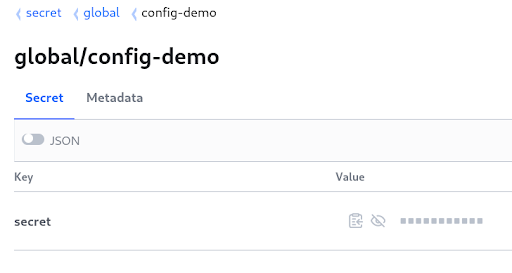
Secrets are stored in Vault in specific paths
secret/global/config-demo is the path
Each path can have multiple attributes
secret is one attribute at this path
In this case secret is autogenerated by default inside the vault directly
By default there are three paths that can be used
secret/global/* accessible by the hub and all managed clusters
secret/hub/* accessible only by the hub cluster
secret/<fqdn of managed cluster>/* accessible only by the fqdn-defined cluster
| You can think of a path as being a single dictionary with multiple keys. An external secret looks for a path and then has a templating system to extract keys and put them in kubernetes secrets. |
secrets:
  - name: config-demo
    vaultPrefixes:
    - global
    fields:
    - name: secret
      onMissingValue: generate
      vaultPolicy: validatedPatternDefaultPolicy
From the vault interface perspective:
ESO Concepts
ESO will read secrets from vault paths (e.g. “secret/data/global/config-demo” is a path)
This ExternalSecret object will read all the attributes of the vault key secret/global/config-demo and will create a secret called config-demo-secret with one entry per attribute.
apiVersion: "external-secrets.io/v1beta1"
kind: ExternalSecret
metadata:
  name: config-demo-secret
  namespace: config-demo
spec:
  secretStoreRef:
    name: vault-backend
    kind: ClusterSecretStore
  target:
    name: config-demo-secret
    template:
      type: Opaque
  dataFrom:
  - extract:
key: secret/data/global/config-demo| How secret material ends up in the vault at a specific path is explained in detail in an upcoming section |
